these leaves.

I've seen a lot of things on the news and in my newsfeed that have made me cringe or cry or both in the last week. Humans are messy (good grief, we're the messiest -- we need some Clorox wipes or a bath or something) and so are the things we do or say or post, and the things that we choose not to do or say or post. Sometimes it feels like no one cares about or loves or fights for each other anymore. Sometimes the world is depressing and you're certain that the light at the end of the tunnel is actually, definitely a big-ass train coming straight for all of us. That we're doomed.

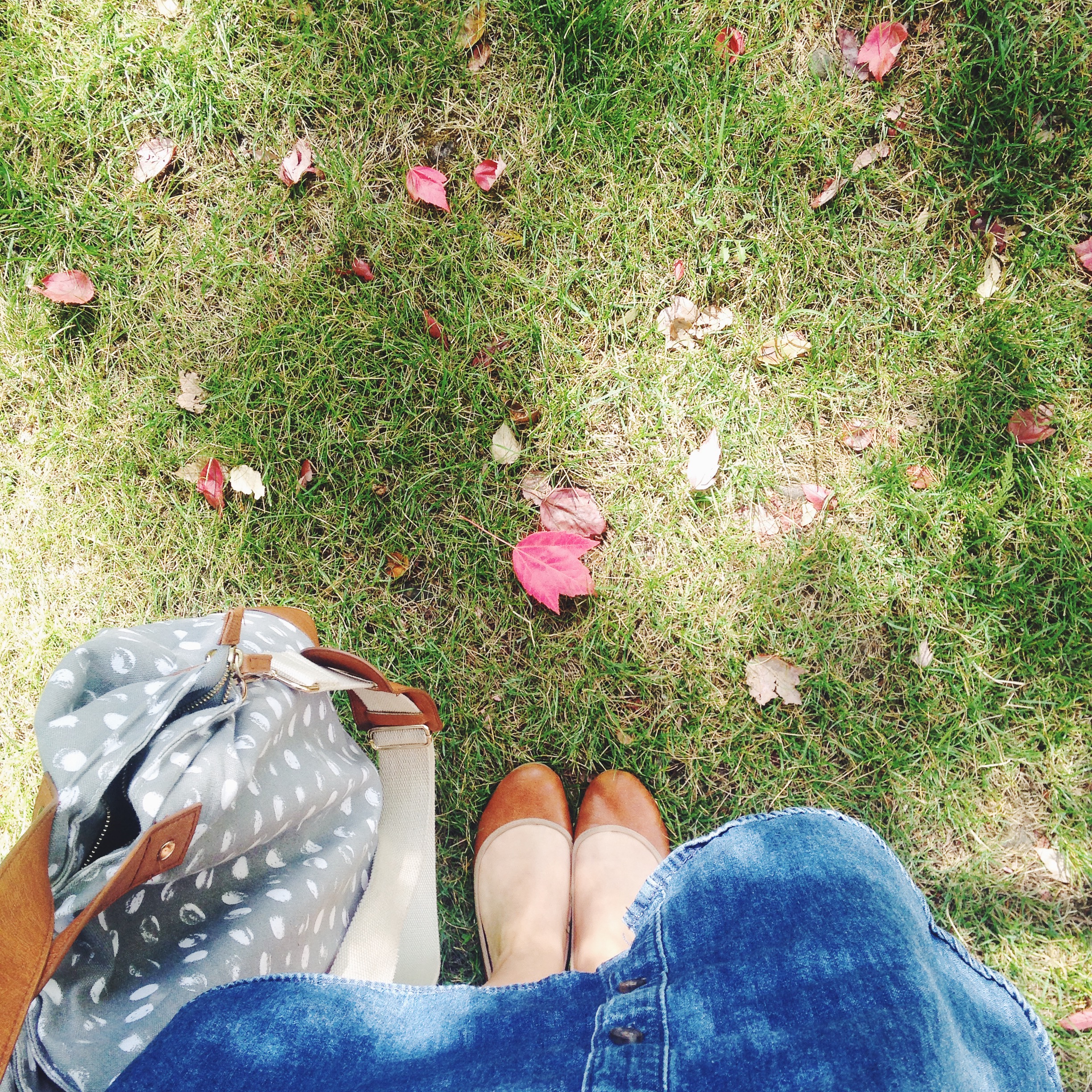
So, with this in mind, posting a picture of my feet on the fall leaves, with my big-ass satchel and denim dress didn't seem right. (You've seen hipster Barbie's Instagram account, right? I fear she will use this photo as inspiration for her next post.) It made me feel out of touch with the realities and struggles of the world, too inwardly-turned in the midst of so much turmoil on this Earth. There are much more important things in the world to post about and talk about and raise our voices about than my feet and fall's arrival. I can think of ten off the top of my head right now. I'm sure I could think of another twenty if I really tried.

However. Here it is. My feet, my big-ass satchel, the fall leaves. Instagram Post #617. This post will be one of hundreds that will plaster the social network as the leaves begin to change colors, boots are pulled out of closets, and the Pumpkin Spice Latte makes it's return (which, as a new coffee drinker, I'm stoked to try for the first time). It will show up under #fallfeet and #fallishere and maybe be liked by people from around the world who are scrolling through the hashtags, spending their mental energy finding other people who have taken photos of their feet, their big-ass satchels, and the fall leaves. We live in a messy world, a world where we can mindlessly scroll on Instagram for hours and forget about those ten things that are much more important than the mindless scroll. We live in a messy world, where we can't even open the app for 48 hours because it seems so stupid compared to what's happening outside of the screen. 

So I'm finding middle ground, or trying to, to bridge those two messy realities. This picture is a #feetstagram, yes, but it's also a virtual representation of a pause that we all desperately need. A reminder that it's okay to take a deep breath (and a deep break) from all of the cringe- and cry-worthy things so we can show up to them again. And raise our voices and talk and post about them again. Taking a break (or posting a photo of our feet or our coffee or our face) doesn't mean that we care less or are no longer "good," conscious people or that we're banned from ever being social justice advocates or activists ever again. It means we are human. That we can't always take in everything that the world and the news and our newsfeeds throw at us. That we need to focus our attention on something like Instagram or Buzzfeed quizzes or Gilmore Girls to give ourselves a break.

And yet. It's not fair that some of us get to take a break, when so many humans have literally been running for refuge for days and months and, for some, years; or to take a photo of our feet, when so many of those humans' feet are tired and heavy and sore; or to take a moment to welcome fall outside our homes, when so many humans have not yet found a welcome place to call home. It's not fair, and that's shitty, and that makes me want to cringe and cry some more. But that's the reality of this messy world. And so we do what we can to try to cultivate a life where we're able to show up to the realities of the world as much as we can. Even if that means a photo of our feet.

It happened as I walked across the street to my apartment. I had just been driving in my car from a lunch date with a good friend. I was stuck in unexpected traffic and crabby, and so I (naturally) started replaying the images and articles that I'd come across on the news and in my newsfeed over the last 48 hours. I finally parked my car after 30 minutes of existential crisis. I felt physically exhausted, and I was still supposed to meet someone to go on a run (my first in at least two months) in twenty minutes. I needed a pause. As I walked across the street toward my apartment and stepped onto the curb, I looked down -- and found these leaves.

These leaves caused me -- for the briefest moment -- to see the light at the end of the tunnel as actual light and not a train of impending doom. These leaves reminded me that there are snippets of love and real light in the midst of the cringes and cries that show up on Facebook and CNN. These leaves reminded me to pause and think about all of those who cannot pause, who cannot rest, who cannot find welcome. To whisper a tiny little prayer for them, and for the world, that we may act and speak and care and love others.

To whisper a tiny little prayer for me, for us, that we may care for and love ourselves in the midst of that, too.

for good.

I've heard it said,
That people come into our lives for a reason
Bringing something we must learn.
And we are led to those
Who help us most to grow if we let them.
And we help them in return.
Well, I don't know if I believe that's true
But I know I'm who I am today
Because I knew you.

We needed a song for the 9th grade talent show. 

Someone — maybe her, maybe our choir director, maybe one of our many musical theatre-obsessed friends — recommended a duet from a popular musical that would be just perfect for an alto and a soprano: “What is This Feeling” from Wicked. We didn’t know the tune but quickly fell in love with it: how it played up our personalities (me, the naive goody-two-shoes; she, a bit more sassy), our cheesy choreography (lots of grapevining toward each other and pointing at each other), and the perfectly timed “Boo!” and “Aah!” at the end. We practiced in my bedroom and decorated green and pink t-shirts with our names on the back, like our own kind of theatre jerseys, and performed for the rest of the choir during 3rd period. “Loathing” became our song, and we called it that even though we knew it wasn’t the title. Our non-theatre friends would ask us to perform it in their basements on Friday nights; if they didn’t ask, we’d make them listen to us anyway. 

I stared down at the empty stage, bouncing my legs up and down like I always do.

I sat on stage right, high up in the balcony, nestled between two of my best theatre (and real-life) friends. It was my first time in New York City, my first time to a Broadway show, and my first time hearing the entirety of the Wicked soundtrack. The first note blared from the pit orchestra -- no peaceful musical overview of the show, no calm introduction to the night, just a straight shot into "No One Mourns the Wicked" -- followed by the next note and the next note, and I was in tears. There were no humans on the stage yet, no words spoken and no lyrics sung, but the chords were enough. I don’t remember if I had thought to pack Kleenex, or if someone handed me one after that first song, or if I just sniffled my way through the entire show, wiping my tears on the coat I had bought just for this senior year trip. I do remember turning to my right and grasping one of those best friend’s hands and holding on for dear, dear life until applauding like the high school girls we were when the song was over.

It was always 82 miles. It was always one hour.

Every other weekend during college, I drove north on Friday nights to spend the weekend with my boyfriend at the time. I threw my backpack (thebooks and pens and highlighters replaced with clothes and makeup and a hair straightener) in the backseat, lowered myself into the driver's seat, and grabbed a burned CD from the glove compartment given to me by that same best friend whose hand I grasped so tightly years before. As I merged onto I-94, I pressed play and listened to that same, blaring first note. That hour was almost the perfect amount of time to sing along to the entire soundtrack -- always skipping "A Sentimental Man," but replaying "As Long As You’re Mine" a few times -- before I arrived to my own, 20-year-old, a-bit-more-scholastic version of Fiyero. For that hour each weekend, and sometimes on the return trip, I paused the real world, full of papers and decisions and my own feelings, and belted out words about flying and being green and also being blonde, because when you’re driving alone you get to play both lead roles.

Some things were the same. Some things were different.

A few weekends ago, I took myself to see Wicked. I took the bus downtown instead of wandering through Times Square to get there. I sat center stage in the 2nd tier balcony instead of on stage right. I was alone, but that was okay: I brought my own wad of toilet paper from the bathroom stall just outside of Aisle 4. I still bounced my legs and got butterflies in my stomach as the lights went down. I mouthed the words to every song and laughed along at every joke and found new ones I missed. I spent intermission furiously typing most of these sentences in my iPhone’s Notes, recalling the 9th grade choreography and the senior year trip and the college year drives. I held my breath and then quickly exhaled as (spoiler alert!) Elphaba emerges from the trapdoor. I was one of the first in my balcony to pop up at the curtain call, fiercely clapping my hands and sneakily wiping my eyes. I took a selfie with the poster instead of a dramatic, posed photo in front of the billboard.

It’s amazing how this one little thing — two-and-a-half hours of words and lyrics composed in the late 90s, which was based on a book written in the mid 90s, which was based on a movie that premiered in the late 30s, which was based on a book that was published in 1900 — can show up so frequently and have such a strong hold on my life. It makes me wonder where else Elphaba, Glinda, and that first, blaring note have shown up for people. How have these songs, these characters, and this story shaped and accompanied and held people? Did Stephen Schwartz and Gregory Maguire and MGM Studios and L. Frank Baum know how their music and words would become permanent placeholders in so many lives?

How many other things like that — like songs and books and quotations and even other humans — show up for us?

I wanted to call this essay anything other than For Good. I mean, really — I can’t think of something more creative than the most popular (and semi-cheesy and sentimental) song title of the musical about which I’m writing? But the answer is no, I can’t. Because cheesy or not, these vignettes of my life over the past ten years — involving friendships that have lasted over distance, other relationships that haven’t, and reminders of music’s powerful ability to reach you no matter where you are — have all had a common note: Wicked. Elphaba and Glinda. That first, blaring note is what has shown up for me. I’m sure I could have found another musical, or a song or a book or a human, that has been a similar throughline in my life.

But maybe it’s true, what they sing in “For Good.” That people — and musicals and songs and books — come into our lives for a reason. My duet partner and my Elphaba, Sara. My best friend and my hand-grasper, Catherine. My then-boyfriend and my then-Fiyero. That they bring us something we must learn, even if we don’t recognize the importance of it until years later. How friendships can last across time and distance. How performing will always be part of who you are, even though now it looks a bit different from when you were 14. How it’s okay to take up space and be in the spotlight instead of the ensemble, and how everyone really does deserve that chance to fly. And how we’re led — drawn or pulled, even — to those people and things, those experiences and moments, that help us to grow — into how to be a friend, how to be a girlfriend, how to be a human.

I think I do believe that’s true. I don’t think I would have written this if I didn’t believe that, somehow, the things that show up in our lives are meant to be there. That we are who we are because of them, because of how they have shown up — once or twice or repeatedly, quietly or loudly or sometimes annoyingly — in our lives. That these things know us as much as we know them. And that (and here it comes, the real cheesy kicker you have been waiting for since you read the title of this essay) they have changed us…

For good.

Wicked in NYC, 2009 & Wicked in PDX, 2015

august 17.

IMG_3159.jpg

I've downloaded Timehop, allowing the alerts to greet me as soon as I unlock my phone. I've enabled Facebook's "On This Day," marking the notifications unread until I've scrolled through each memory. I start most days this way: lying in bed after my alarm goes off, scrolling through memory lane. Last year, I Instagrammed the beautiful waterfalls I hiked past while on retreat for my new job. Three years ago, I tweeted about being one week away from hopping on a plane to India. Seven years ago, my best high school friend wrote on my wall to tell me that she would always always always be my friend.

These snippets of the past are kind of like the songs that bring you back to that one night, that one feeling, that one moment in time. But these snippets are always the good stuff -- they're the songs you danced to at that sleepover, the one that played during that kiss, and the one you belted at karaoke. I see the picture of the waterfall and get the same excited butterflies in my stomach that I had as a three-day-old employee. I see the tweet and physically ache for Bangalore and the feeling of hopping on an international flight with my travel pack. I see the post from my friend and immediately screen shot it to her with a few heart emojis, grateful that her promise is still true. These are such good moments.

But what about the rest?

What about the nitty gritty stuff of our hearts and guts that isn't recorded on social media? What about the just-as-real (and maybe even-more-real) stuff of our lives that was around before social media? Timehop and Facebook leave out the stuff that reminds us of the loneliness or the recent breakup or the friendship drama. They don't play the song that we looped on repeat when we said goodbye for the last time, or the one that we had to avoid for awhile, or the one that has always made us tear up a bit. There aren't many Instagrams or tweets that bring up hard stuff, or under-the-surface stuff. This is, of course, by our own choosing -- we purposefully record and remember the butterflies over the breakups, the excitement over the dread, the "life is great" over the "life is great but also really complicated." But still, we feel the real stuff's absence; it's the missing part of our perfectly crafted and curated scroll down memory lane each day.

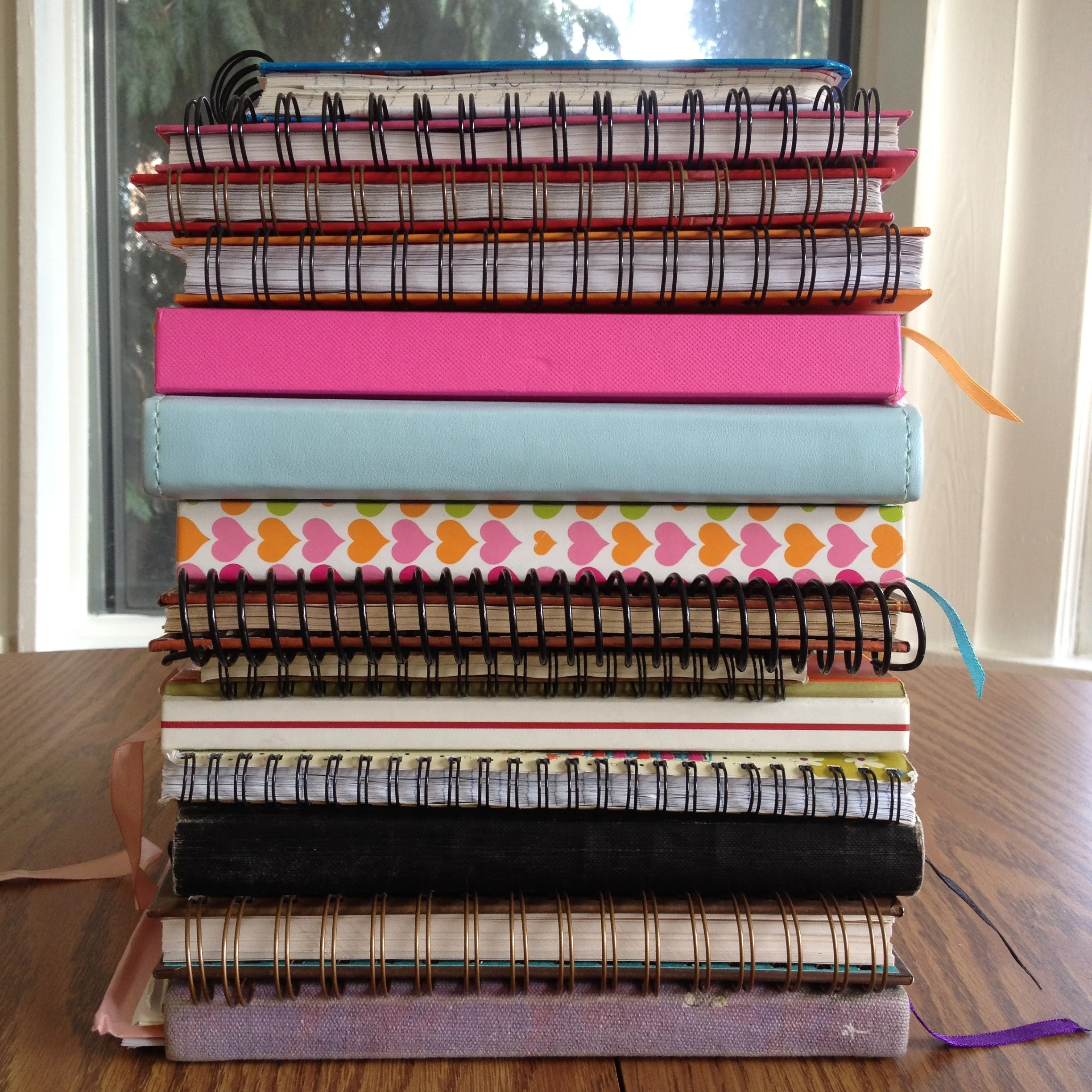
I needed to look up a date and a memory for an essay-in-progress in an old journal tonight and found that real stuff staring at me from the pages of my bright orange, tulip-covered journal from the summer of 2005. I flipped through pages and found unsent love letters to multiple boys, printed transcripts of AOL Instant Message conversations with those same boys, and my insights into friendship and relationships and school. I found today's date.

August 17, 2005: "I'm ready for school to start. Pumped. I love rain. Last night we went to bed at 5! Time for me to roll out = now (11:22)!"

I read the full entry, giggling alone in my apartment and wondering why I ever thought I should use the phrase "roll out," even if it was just for my eyes only. I returned the journal to its box and pulled out my bright pink, daisy-covered one from the summer of 2006.

August 17, 2006: "He was like 'Where have you been?' and I said 'around.' He was like 'around, huh?' and I said 'Yeah I've sent you a few texts the past few days' and he goes 'yeah' and some other stuff. He said he'd try to call me sometime. I think it was fate."

First, I laughed. (Fate? Really?) And then I kept searching through the pages, unearthing the multicolored hearts and flipping open the elephant with the balloon and holding the engraved feathers, finding the under-the-surface words and feelings from each August 17, the stuff and stories that my Timehop and Facebook wouldn't bring up each year.

August 17, 2008: "I went to a High School Musical 2 party! It was super fun even though I didn't know everyone there very well!"

August 17, 2012: "I explained that I couldn't let him take me out to dinner because I had just gotten out of a long-term relationship and am going away. In other words, this is how my heart feels: UGGGGGHHHH!!!!!!!!!"

August 17, 2014: "How on earth will I know if this is the right path for me? Don't I just need to take one step and then see how that goes? What if I change my mind? Then I do. Dreams and plans and timelines can change. They always do."

As I read each entry, I moved past the picture-perfect parts and into the "life is great but also really complicated" ones. There wasn't a filter or spellcheck or missing snippets in this memory lane. It was all there, messy handwriting and weird analogies and rambling monologues and all. 

And now, this one's there too.

August 17, 2015: I had already Instagrammed my three closest gals from our 7 am breakfast date today. I took my first coffee art photo and started writing my "I just started drinking coffee" Instagram post in my head. I snapped a few pictures of my students, capturing the silly icebreakers and the birthday celebrations and the sacred conversations. But there is more to this August 17 than these good, post-worthy snippets. There was the walk home from work -- to a home I've been living in for over a year now, to a bed which is finally unlofted after an epic battle with the mattress and frame. There was the writing about Wicked and watching Ross and Rachel and their new baby on Friends and, now, the reliving of so many August 17s. Good and hard, big and little, and under-the-surface pieces that make up this day.

According to Timehop and Facebook, August 17 has not been a special day in the history of my life. Except that it is. Of course it is. Because life -- good, bad, and real -- happened then and is happening now. August 17 was fun in 2008 and heartbreaking in 2012 and insightful in 2014. And now, in 2015, it's an ode to my journaling, or to anyone's journaling, or to creating an outlet to remember the under-the-surface, "life is great but also really complicated" stuff somehow. It's also a reminder that memories exist outside of those that social media reminds us of, that the unseen and undocumented snippets matter just as much -- if not more -- than those that show up on our screens. And it is a plea to my future self, who will see this on August 17, 2016: sit with and learn from and let all the snippets of your life, from August 17 and all the other days, show up beyond your screen.

Let them live in your heart and guts.

i'm sleeping on the floor.

“I’m sleeping on the floor.”

It was the middle of the night in the middle of a 36-hour Amtrak ride from Portland to Fargo, and we were trying to figure out just how we were going to sleep. Falling asleep is hard when you’re squished into two seats that only recline 45 degrees. It’s even harder when your seat partner has five-foot femurs (Steph) and when you have never been able to fall asleep on a moving vehicle (you) and when you’ve already been on the train for 24ish hours (both of us, along with 14 other students returning from an intense alternative break trip where we slept on a church floor for seven nights). After shifting and cuddling and tangling our limbs, we decided that our best chance at success was to divide and conquer: one of us would lie across the seats. And the other would sleep on the floor.

This sparked the biggest “fight” in our almost-six year friendship. And by fight, I mean we spent the next 30-ish minutes discussing, debating, and arguing over why the other person should be the one to sleep on the train seats. Steph is the most stubborn human on this earth and explained all of the logical reasons why I should get the chairs: I had just worked so hard to coordinate all the logistics for the trip, and didn’t I have to work in the morning?, and she would actually have more room for those five-foot femurs if she could stretch out on the floor. I don’t have a persuasive bone in my body, so I’m sure I just said things like, “But, but...no! You take the seats!” or, “No, Steph, I really don’t want to sleep on the chairs. I like sleeping on floors!” We went back and forth, raising our voices ("NO! I am!") and making empty threats ("I won't talk to you for a week if you won't sleep on the floor!") and laughing ("This is ridiculous -- we could have been sleeping by now.”). We kept saying, "I'm sleeping on the floor," only to be met with, "No, I'm sleeping on the floor."

We've said this sentence hundreds of times to each other now. When I stay late to do the dishes after she’s invited me over for dinner, because I know she hates them and we’re far past the point of the typical “the hostess has to take care of everything from start to finish” relationship but she still argues with me: “I’m sleeping on the floor.” When she gets in her car before I can protest and drives across town to pick me up because my car's fender is about to fall off, and then claims it gives us an extra 15 minutes of catch-up time before I can apologize: “I’m sleeping on the floor.” When I stay long-after the end of a sold-out pizza and pie event to haul garbage and unload the uHaul and then drop off the uHaul with her, only to then be accompanied to my post-midnight housesitting and cleaning and laundry duties, even though she’s been pizza-ing and pie-ing for 17 hours: “I’m sleeping on the floor.”

“Me too."

I don’t remember who slept on the floor that night on the Amtrak. Honestly, I’m sure we both did at some point. But who slept where isn’t the point of this story. Keeping tabs on who slept on the floor, or who did the dishes twice in a row, or who paid for the last beers during happy hour — these things don’t have a place in this deep, true friendship. It’s an unspoken rule: we give when we can, whether that’s doing the dishes or taking the check or sleeping on the floor, and we take when we need to, whether that’s staying seated for an extra five minutes or pocketing that extra five dollars or curling up on two Amtrak chairs. Friendship is all about that give and take, push and pull, yin and yang, floor-sleeps and Amtrak-chair-sleeps. Sometimes you sleep on the floor, sometimes she does. Sometimes you join each other down there because you'd rather just be together, even if it means being squished next to her five foot femurs.

In Steph, I have found a soulfriend who laughs and cries and dreams and frets and rages and eats and shares and exists — so authentically, so compassionately, so truthfully — and meets me wherever I am in my brain or my day or the world. I hope that you, too, find a friend who will join you where you are, who will sleep on the floor for — or, better yet, with — you.

Before the Amtrak Debacle of 2013. (Portland, OR -- February 2013 -- Photo: Cathryn Erbele.)

Before the Amtrak Debacle of 2013. (Portland, OR -- February 2013 -- Photo: Cathryn Erbele.)

this is a public service announcement.

This is a Public Service Announcement.

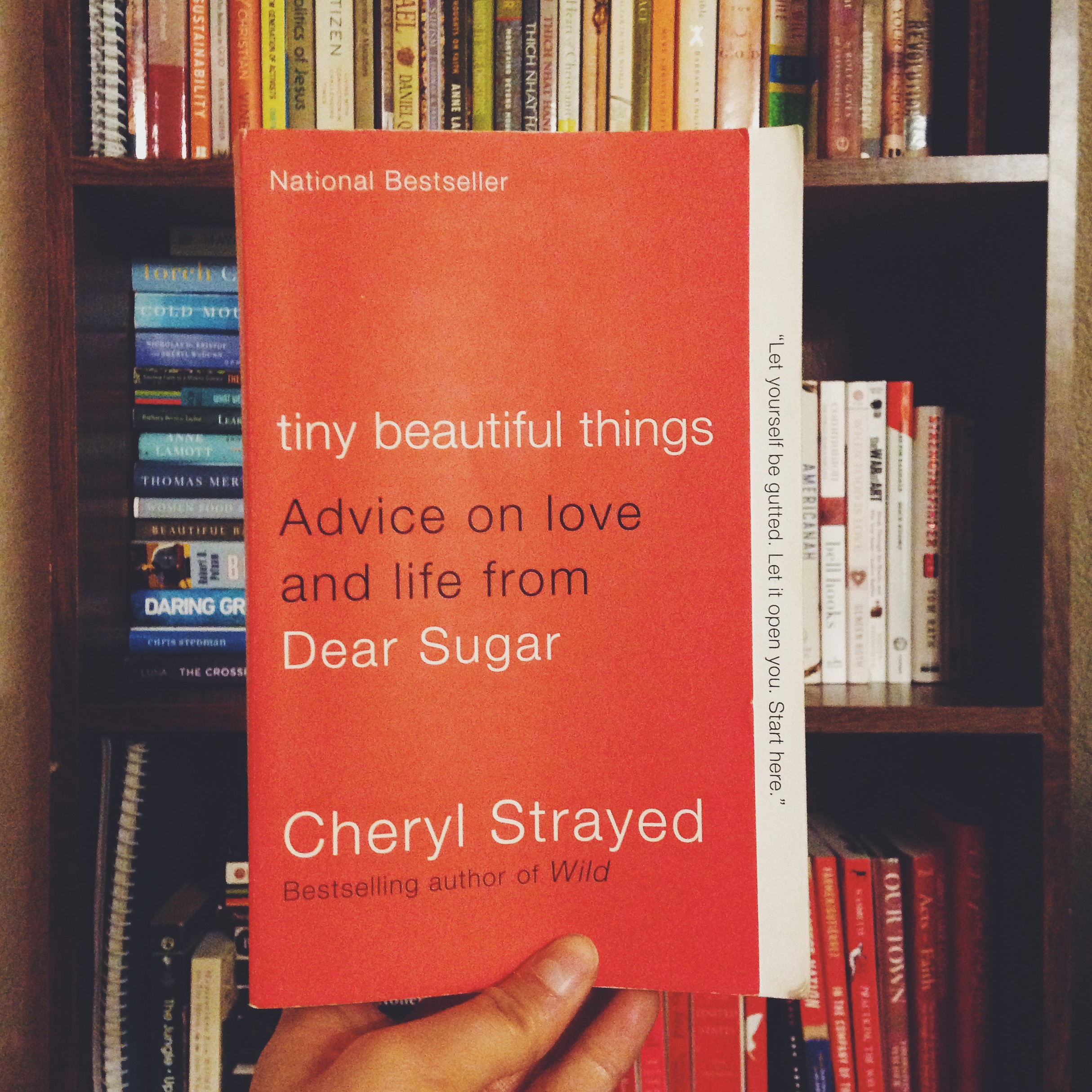
Stop scoffing at how the subtitle of this book includes both "advice" and "love" and is written by someone called Sugar. Forget everything you think you know about advice columns. Tuck away your feelings about how silly they are. Set fire to the idea that only desperate people write in to them. Whether you are a 24-year-old living far away from home or a 62-year-old who has never left home, there is some part of your life that needs both advice and love. From Sugar. Accept that no matter how finely stitched or tightly wound or perfectly scheduled your life is, there is always room for more love.

Google Map your local library or used bookstore or not-used bookstore. Go there. If you can't go right now, put a Post-It in your paper planner or an appointment in your iCal so you can go as soon as you have an hour of freedom from your job, your other job, your responsibilities, or your other responsibilities. Get it in your hands. (Don’t use an e-reader.)

If it's not there, put it on hold. Request that another copy be ordered for you and shipped to the store, or better yet, to your front door. Don’t wait and return in a week or two or when you know you'll have more time to read. You won't go back, because you'll come up with all sorts of excuses as to why you don't have enough time right now. Right now will turn into this summer will turn into this year will turn into this life. There is never enough time in life to read things that aren't gross bills reminding you of the capitalist patriarchy, or the airline credit card offers that show up in your mailbox every Monday, or the textbooks you're supposed to want to read because their titles match your future degree. Get it now and find the time later. Make a habit of reading one chapter before bed or getting up one hour early to sit in your lime green chair with the next chapter. 

When you have the book in your hands, flip through the pages. Read what Sugar says inside the front cover. Look at the empty margins, the crisp corners, and the meager 26 letters filling 353 pages with thousands of words and maybe just as many revelations for your life. Now move the book into one hand and grab a pen with the other. A highlighter works too. Whisper a little apology to the book; because by the time you get to this line on page 15 -- “The best thing you can possibly do with your life is to tackle the motherfucking shit out of love” -- you will already have covered it with ink and tears. You will have smudged it with your greasy face oils as you buried your face deep into that sentence and breathed in its truth. 

Dog-ear the top corners so you can use that quote on page 130 for an Instagram caption, or so you can easily find 'The Ghost Ship That Didn’t Carry Us’ to read out loud to your roommate one rainy night, or so you can remind yourself of whatever you need to be reminded of next week or next year. The questions you need to ask yourself will come hurtling through these pages straight into your gut. They will lead you to answers that have been there all along, but have been in hiding or hibernation because they will bring a devastating but maybe-much-needed hell that may or may not turn into a definitely-much-needed heaven. Turn to page 155 to be reminded that "every last one of us can do better than give up." Wherever this book brings you to in your life, it will be okay.

Put it on a shelf, or better yet, near your bed. Pull it down when you are full of uninhibited joy and naïve optimism, and pick it up when you are completely drained of those things. Especially then. Read your favorite column, the one that speaks to you and resonates with you and makes the world seem a bit brighter. Read it again. Read it one more time, out loud to yourself. Tell your friends about it. Make them sit criss-cross-applesauce on the floor with you or on the other side of the FaceTime screen with you as you say the salutation ("Dear Sugar") and until you say the closing ("Yours, Sugar"). They will listen to Sugar's words. They will listen to yours.

If you find that this book was not for you, give it to someone who might make it theirs. Let it feed them. If you find that this book was perfect and made for you, still give it to someone so they can make it theirs too. There is enough for everyone.

Eventually, you will find another book. Get a title from a friend, mentor, or stranger on the bus. Ask them about one that has moved them, rattled them, taken care of them in a way that only books can. Remember the title. Write it down. Thank them for it. There is nothing stronger and more intimate than recommending a title to someone, and having them read it.

Then, if they ask for a recommendation in return, share this -- or your very own -- Public Service Announcement for your favorite tiny, beautiful book.