buy the song.

I have one song in my iTunes library.

I downloaded it on a late, hot August night, when almost a hundred people crowded into a home just a few blocks away from where I had spent the last four years studying, working, and becoming. Everyone was there to play beer pong, eat chips and salsa and chips and hummus, and have one last reckless summer night before “real life” started again in September. Most of them were there to say goodbye — to me and Steph, as we prepared to drive a UHaul (which was already parked in the driveway, already halfway loaded up with our lives) across the country to start anew in Portland. You know the rest.
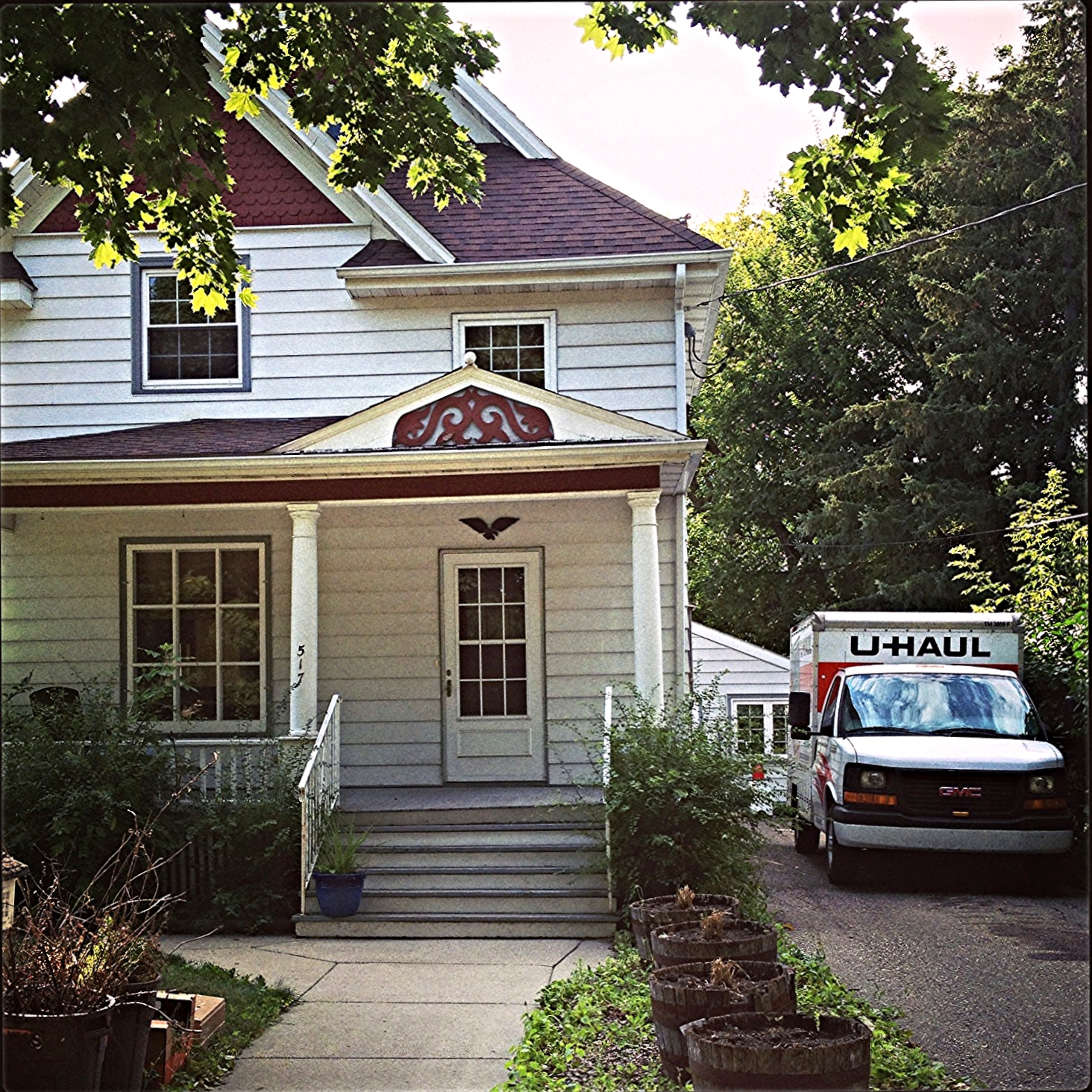
I remember a lot of things about that night. I remember sneaking upstairs with one of my best friends and crying over the card she gave me and realizing our friendship would forever be altered the minute I pulled away from our hug and from Fargo. I remember sneaking away from the party to play on the nearby playground and swinging, swinging, swinging like I was in second grade again. I remember the police officer who knocked on the door, telling us that the party was over and one of our guests telling him it most certainly was not. This was my first real house party. It was all so real and all so cliche and I couldn’t stop smiling the entire night even though I was saying goodbye to all of my people. I felt like I was in a really great and really cheesy movie about college and growing up and moving on. I was, in a way. In my own movie. I was, in a way. Growing up and moving on. It was all perfect.

But I also remember this one moment — the one where I paid $1.29 to download a song. That night, my phone played the songs that kept getting interrupted by the people calling and texting, asking for directions. I turned on Spotify radio for most of the night and let BOY, Haim, and a few Top 40 hits flood the first level of the house and spill into the backyard. Somewhere between a few and several beers into the night, a few guys marched up to me with a request.

“Can we play a song?”

“Sure,” I said, as I handed over my case-free and already-cracked iPhone.

What I don’t remember is how they exited my Spotify app, bypassed searching for it on my YouTube app, and instead found it in my iTunes app and determined that this, this was the best way to listen to their song. I do remember someone passing my phone back to me a few minutes later with the “Sign In to iTunes Store” pop-up window right there, so I could authorize the purchase. I remember looking at their eager faces and giggling as I squinted at my screen and shook my head and thought how I’d spent $1.29 on worse things.

Maybe sometimes we make a choice because it will make others really happy. Or because they have kindly asked us. Maybe sometimes we make a choice because we truly, honestly don’t give two shits about the outcome. Or because we’re curious and feeling carefree. Maybe sometimes we make a choice because we think of all the harder choices we’ve made and then this one comes rushing in as a relief, an easy one, a mindless one.

I handed the phone back to them, and they set it up on the speakers, and then — it started.

“Choices,” by George Jones.

I would never have guessed in a trillion years that acoustic, country chords would gush out of my phone just then. I thought it was going to be Space Jam or R. Kelly or Jump Around or something that we all would have been excited about and then danced to or karaoked to or jumped around to. The guys who requested this song were the only people in the room who swayed and sang. (If you listen to it, you’ll realize it’s not really a song to jump around to.) I think I did a few sympathy sways with them and then went to the snack table. The party went on. (Until the cop finally did convince the previously mentioned guest that the party was most certainly over.)

There isn’t really a moral to this story. I plugged my phone into my computer for the first time in a long time tonight, and my iTunes library popped up with George Jones’ face and his dark sunglasses looking off to the left, and I immediately knew I wanted to write about it. It seems insignificant. The guys probably don’t even remember that they are the guys who did this. The others at the party probably won’t even remember this happening. But I do. I remember. And isn’t that a good enough reason for a story?

I could have deleted the song the morning after the party, as I ran through the night in my head and checked my iTunes to make sure I really did download it. I could have deleted it in the UHaul on the drive out here, as I cleared out the old on my phone to make room for the new. I could have deleted it any time in the last two years, as I plugged my phone into my laptop to save the pictures that have captured my life since that night. Instead, I’ve listened to “Choices” on repeat as I’ve written this, not only to make my grandmother proud that I’m listening to “her kind of country music,” but also to remind myself that a choice is just a choice. It’s not the end of the world or the start of our lives, even though it feels like everything in our world and our lives depends on it. We’ve made choices before and we will make them again. We will sometimes make the same choice over and over and over again and we will sometimes choose differently every single time we’re faced with it. Big and little choices, easy and hard choices, choices for others and choices that might make others mad or sad but that finally — finally — free us.

Life has us make choices all the time — sometimes ones that we are prepared for, sometimes ones that we will never be prepared for, and sometimes ones that shake up our souls in awesome and awful ways. Sometimes at the same time.

And sometimes, if we are lucky, life has us make choices that we just have to close our eyes at and throw our heads back at and giggle at as we type in our iCloud password and buy the song.
one book book club.

Why did people ask, "What is it about?" as if a novel had to be about only one thing.
-Chimamanda Ngozi Adichie, Americanah

I signed up for English 160 on a whim.

It looked interesting (it was), it was a night class (which meant more time to hang out in the Atrium, my college's social hotspot, during the day), and it counted for a required humanities credit (thanks, liberal arts).

On the first day, after passing out the syllabus and talking through the assignments and giving us a short break halfway through the three hours, Dr. Joan Kopperud showed us author Chimamanda Ngozi Adichie's now-famous TEDTalk, "The Danger of a Single Story." I had never met Dr. Kopperud before, and I still didn't know what to expect from this course, but after hearing Chimamanda speak the words, "When we reject the single story, when we realize that there is never a single story about any place, we regain a kind of paradise," I realized two things: one, that Monday nights from 6:00-9:00 pm were going to be a literature heaven-on-Earth, and two, that I needed to get to know this professor.

The class came and went each week. I would dash across town from my internship, dash across campus to Academy Hall, dash up to the third floor, books and dinner and highlighters in hand. I would sit in my desk (the same, awkward, left-handed one every week), listening to freshmen and seniors and Dr. Kopperud share thoughts on each book we read. We read fiction and nonfiction and poems and plays that were single stories from India, or Saudi Arabia, or England, or the Democratic Republic of the Congo. I questioned why I had decided not to become an English teacher; I wondered how I could live a life that wasn't surrounded by reading and sharing literature with others every day. I panicked that I hadn't chosen the right major; I poured through the course catalog and my senior year schedule, trying to squeeze any other English courses into my last two semesters (I didn't). And, I (eventually and timidly) asked Dr. Kopperud if she would have coffee with me outside of class. She, with all her energy and kindness and openness, agreed.

A class that started as a core curriculum requirement quickly became a space to confront the unknown in each chapter, ask questions about each story, and write not-totally-researchy papers about them. A professor that started as a name next to the most ideal class time quickly became a mentor, cheerleader, and permanent book-recommender. She also became the person who gifted me a hardly-used food processor before I moved across the country, who makes time in her schedule to grab coffee when I'm back home from across the country, and who ventured to my new home across the country with another of my college-year-and-still-now mentors. The whims -- the things you hardly think about, the things that require minimal brainpower at the time, like entering the Course Registration Number for English 160 as you register for the spring semester of your junior year -- can burrow deep into your heart and stick around to shape your own story.

During our coffee date this January, over Starbucks and swapping book titles, I mentioned how I wanted to join a book club in Portland, but felt a little overwhelmed by the idea. (Once a month? Sometimes it takes me two months to get through two short stories. Saturday mornings? I don't leave my room until at least 11:00 am. Through a Meetup group? Maybe I'm more of an introvert than I think I am...) Dr. Kopperud, with that same energy and kindness and openness as when I first asked her to coffee three years before, leaned in and smiled. She went on to tell me what she's been doing with her girlfriends for years: a One Book Book Club.

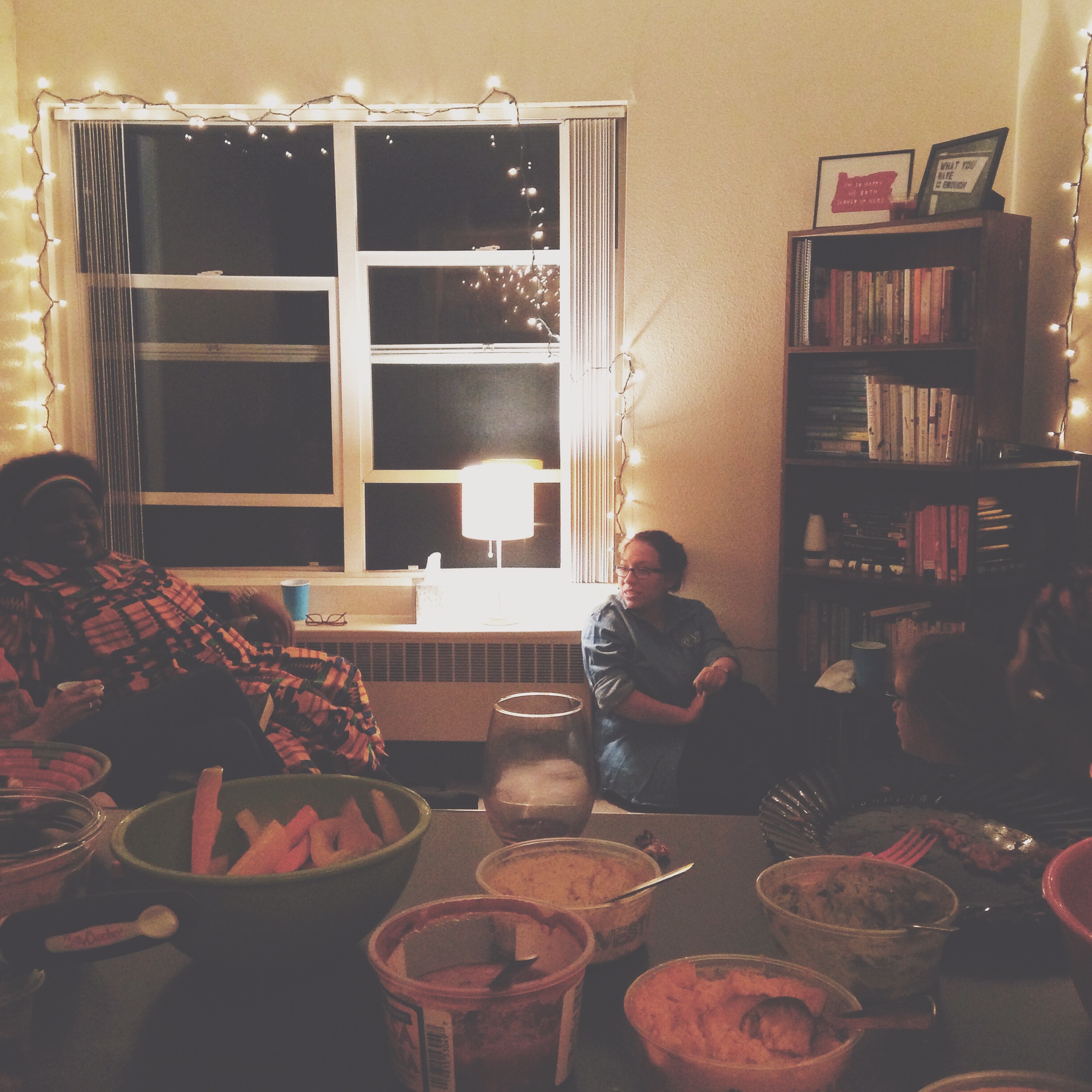
So tonight, I made a sign for my apartment door and threw some frozen pizzas in my oven as a group of women gathered around a pile of Americanahs in the middle of my living room floor. Some had read the book in its entirety in two days; some had yet to crack open the cover. We were from Arizona and Zimbabwe, rural and "urban" North Dakota. We were full-time employees and students and volunteers, part-time writers and dancers and yogis. We shared our own stories and learned more about each other's as we talked about this single story and all that it brought up -- race and gender and love and privilege. One book, one evening, and one club that (I hope) will shift and grow and share more books and more evenings and more stories; a One Book Book Club.

I still have each book I read during English 160. They sit ear-marked and underlined on my bookshelf, next to an ear-marked and underlined Americanah by Chimamanda Ngozi Adichie, reminding me of the danger of a single story (and how whims and 20-minuted TEDTalks and energetic, kind, and open professors can make your own story much more interesting and full circle-y). Now, every book that is a part of the Portland edition of One Book Book Club will, in some small way, be part of that semester -- and will be a part of my story too.

i need help.

I wanted this post to be published this past weekend and I wanted it to be about something else entirely. I don’t know exactly what it would have been about; maybe about what it’s been like to be single for the last two-and-a-half years or about why we feel that spark with this someone and not that someone or how every day should be Valentine’s Day with yourself. I didn’t have it written or planned because I had arranged my week so I could plan and write it then.

sickessentials

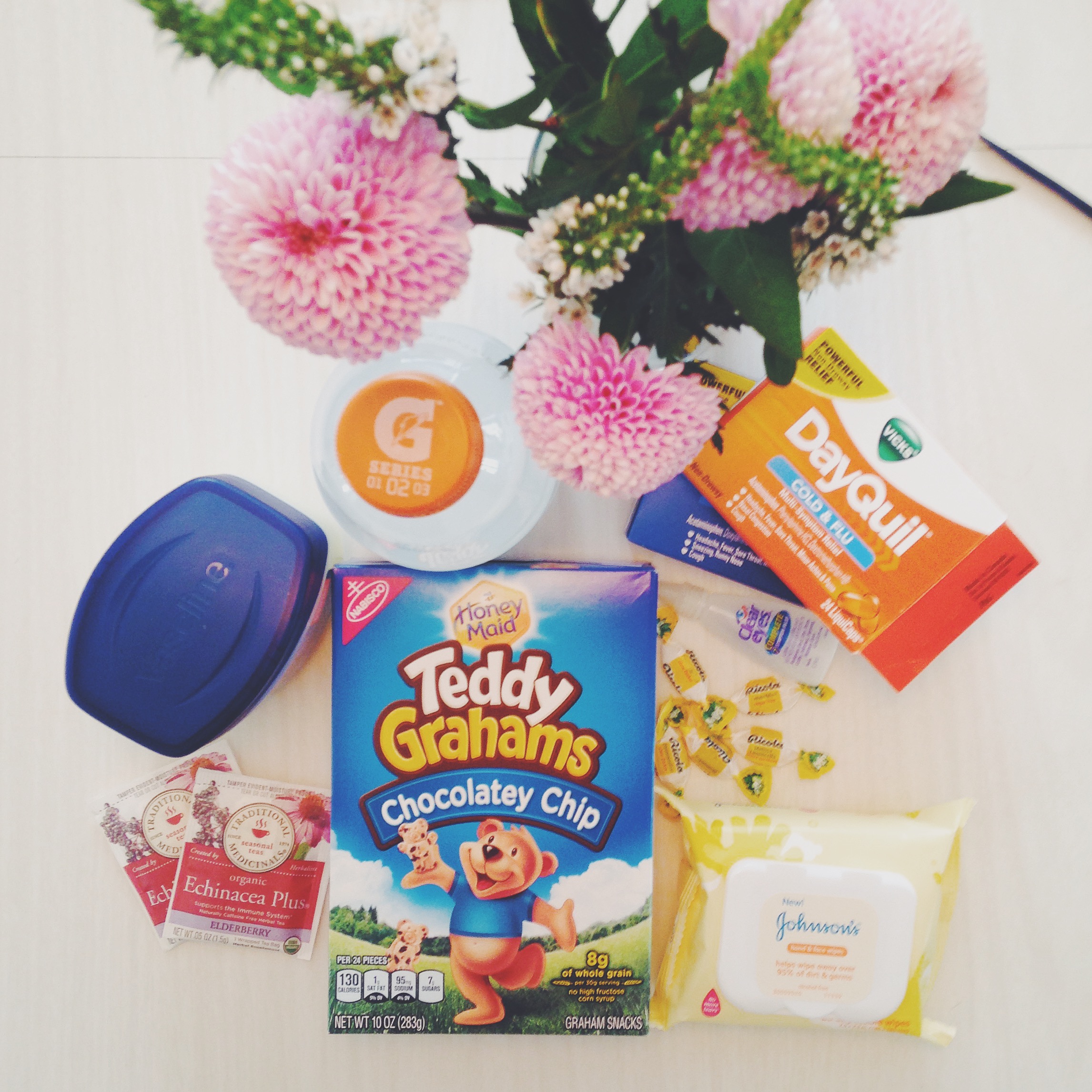
But sometimes the arrangements we make in our new, mostly blank paper planners aren’t what actually happens in life. Last Tuesday night, I came down with The Plague. (Think of every symptom of the flu there is and multiply it by five and I’ve had it for the last seven days.) I’ve spent my last days in hibernation. Without much energy or focus or the ability to be fully present with anything, I’ve done a lot of napping, binge watching ‘Friends,’ and cuddling the cute pup I’m sitting for all week. I haven’t been eating, reading, working, or — as I wanted to — writing a blog post related to Valentine’s Day. I had to miss tea dates with friends, important Leaven meetings, and a huge event at work that I was supposed to supervise. The Plague put my life on hold.

But even though I wasn't able to follow through on my responsibilities (or move far from the couch), things still needed to get done. I needed to put some calories in my body. I needed to take this 6-month-old, energetic dog for a walk every day. I needed 40 college students to be supervised as they sold cotton candy around campus all weekend. The rest of the world—even my world—wasn’t stopping just because I was. I needed things to get done without actually being the one to do them.

I needed to ask for help.

Even writing that sentence makes me cringe. I needed to ask for help. I hate that phrase, and specifically that word—“help”—more than most. I have always equated “needing help” with being incapable, incompetent, or inferior. I have nailed the cycle of agreeing to do something I know I actually shouldn’t agree to do, doing it without asking for help from anyone, and repeating this cycle with high frequency even though at the end of each one I tell myself, “Never again.” But then there’s the part of me that feels weirdly proud when I’ve gone “above and beyond” (although, behind the scenes, I’ve worked on a Sunday night, stayed up until 2:00 am, or sacrificed time to practice a little self-care and Sabbath); I feel like I’ve won a contest that I shouldn’t have signed up to compete in at all. I’ve always prided myself on being able to do it on my own, to take on that extra task, to put in the extra effort—and to do it all without any complaints. By not asking for help, I prove to the world that I am a capable, competent, and superior being. That I am, in fact, SuperHuman. That I can, and will, do it all, thank you very much.

But with my nose running and my head throbbing and my body shaking, I let go of that high-pitched, self-assured voice that lives in my brain and says, “I can, and will, do it all, thank you very much.” I knew that I couldn’t, at least not this week. If I had tried, I would have half-assed everything, including my recovery, which would have probably restarted the cycle of The Plague and left me utterly hopeless in all parts of life for an additional week. Anne Lamott, my spiritual director from afar, writes all about this in her book Help Thanks Wow. She says:

“When we think we can do it all ourselves—fix, save, buy, or date a nice solution—it’s hopeless. We're going to screw things up. We're going to get our tentacles wrapped around things and squirt our squiddy ink all over, so that there is even less visibility, and then we're going to squeeze the very life out of everything.” 

I didn’t want that. Even in my stubbornness of not wanting to ask for help, I still wanted things to be done—and done well. So instead of trying to half-ass my life for the week, I gave up and delegated parts of it. I asked for help.

Can you bring me over a Jimmy John’s sub sandwich, because it’s the only food that sounds appetizing to me right now? I can’t go get it myself, and I need help.

Can you stop over and take the dog for a walk and feed her lunch so I can go to the walk-in clinic? I can’t do it, and need help.

Can you supervise a huge, three-day work event in my absence? I can’t be there, and I need help.

Those were hard texts to send. But after pressing send, after seeing they were delivered, after waiting for those three little dots to stop typing, each text was met with the warmest, kindest, grace-iest response:

Yes.

Yes, I will bring you over a sandwich. And I will get your sandwich order correct without even asking you what it is and I will bring you two drinks to choose from and also a chocolate chip cookie for dessert or for breakfast tomorrow. Yes, I can help you.

Yes, I will take care of the dog. And I will bring you some pretty flowers, some delicious tea, and some kind words to help you heal. And I can come back tomorrow, too. Yes, I can help you.

Yes, I can make sure that tables are set and volunteers are there and money is counted in your absence and I can even let you know how it’s going if you’d like that. Yes, I can help you.

There it was. The words I was the most scared of sharing because I was worried that people wouldn’t want to help, that people would think less of me for needing help—those were the same words that elicited responses and actions and words of love. They were Jimmy John’s subs and vases of pink flowers and successful fundraisers. They were encouragement and support I didn’t know I needed until I asked, and they were encouragement and support I wouldn’t have received unless I asked.

There were plenty of other things that I could have, and probably should have, asked for help with this week. I’m learning the balance of what I can do alone, what I should do alone, and what I don’t have to do alone even though I can. 

So while this isn’t a Valentine’s Day post, it kind of is. Asking for help can be vulnerable and hard and downright scary when we live in a world that says that doing so makes us weak, inferior, and second-rate. But asking for help can lift us up; when we ask those we love, and who love us, to carry some of our weight when we cannot, we enter into a relationship that allows both parties to feel a sort of trusting, quiet love. A long-lasting, sturdy love. A I’ll-scratch-your-back-if-you-scratch-mine-too kind of love.

And is there a better kind of love than that?

fargo.

“Where are you from?”
“Where’s home for you?”
“Where did you grow up?”

A month ago, I hopped on a red-eye flight to my answer for the first time in a year. The last time I was in Fargo, I had been in Portland for a measly four months and was still very much in the honeymoon phase of my new life there (I can bike everywhere, even in December! I live within walking distance of a Whole Foods and a Target! I actually made friends!). I loved that visit to Fargo, but I was still trying to make Portland feel like home. I was eager to return to my half-built life on the West Coast; I didn’t want the honeymoon luster to wear off while I was away. I was worried that if I let myself rebuild things too much—that if I picked up right where I had left off in August—that it’d steal from what I had started to build in Portland. 

Basically, I didn’t believe I could have Portland and Fargo as home; it had to be one or the other.

So Fargo became my hometown, not my home. It became the life I once lived but wasn’t living anymore. I told people in Portland who asked the “Where are you from?” and “Where’s home for you?” questions that while I was from the Midwest, I lived in Portland now; this was home. I reasoned that home couldn’t be a place where I only visited at the holidays. Home was where the real, messy growth happened every day. Home was where I showed up and tried my best or, sometimes, gave up. It was where I walked in the rain and caught the 17 line. It was where I sent hundreds of emails and sat on committees. It was where I met friends for tea and happy hour, where I scrubbed floors and ate standing up at the kitchen counter way more often than sitting down, and where I grappled with questions of faith and vocation and injustice. It was where I felt joyful and peaceful and determined, and also where I felt lonely and confused and stuck. It was where I pictured myself living in a week, a month, a year.

I also wanted to claim Portland as home. I wanted it to be known as the city where I’d be in a week, a month, and a year. I wanted to prove that I had done it, that I had found a place and made it mine, a place that was just as special to me as the place where I had spent the first 22 years of my life. A place that wasn’t just part of the "I-just-graduated-college-and-need-a-wild-adventure-so-I'll-just-move-across-the-country" phase. A place that wasn’t just the next stop in a long line of them. Portland was more than that to me, so I crafted it into a home.

So when I hopped on that red-eye flight a month ago, I wasn’t sure what to expect from my visit. I wasn’t sure how to exist in Fargo while still being true to the home I left out West, the only home where I believed the real, messy growth could happen for me now. But as I got off the plane and slowly immersed myself back into my Fargo life, I started doing what I did in Portland. I put one foot in front of the other each day, opened my eyes each morning, and existed in the world the same way. (Or, at least mostly the same way. I had to drive a lot more because of the, you know,  -35 degree weather and wore more scarves than normal for that same reason.) But just like I did in Portland, I showed up, tried my best, and asked a lot of questions. I let the real, messy growth happen.

I was only in Fargo for two weeks, but I made it home. I allowed myself to find home there. I tossed out this silly idea that I could only have one home, and instead let myself believe that there was enough love and comfort and homeyness to go around in places that are 1500 miles apart. I did more than just show up in Fargo; I grabbed the microphone and took the stage and belted as loud as I could.

I chatted with my 8th grade boyfriend, my junior year fling, and the man I kissed before moving to Portland. In the same night. At the same bar. I was the least helpful member of a trivia team, but was still invited back to play the next week. I disrupted an entire restaurant during dinner because who can contain laughter when talking about high school love?

I sat across from college-year mentors—professors and bosses and advisors, sharing tea or hot chocolate or a meal—who are still mentors, but now, are also friends. I baked sugar cookies from the same recipe, in the same mixing bowl, and with the same kind of sprinkles that my family has used for as many years as I am old. I navigated from one end of town to the other without checking Google Maps, accurately guessed how long it would take get there, and never needed to parallel park. Ever. 

I connected with someone I’ve known from a distance, ate at restaurants that didn’t exist a year ago, and stayed in a new house with a new dog and a new family member. Fargo reminded me of the life I wasn't living full-time anymore, but that didn't mean I had to hold back from life there. Fargo was full of life. Old and new, fun and serious, good and bad. And home is where there is life.

Home is Fargo. And home is Portland. Home is wherever you find it, wherever you are or allow yourself to be in a given moment. Wherever you find yourself surrounded by—or sometimes looking for—love and people and life. Or wherever you find yourself surrounded by—or sometimes running from—challenges and questions and the hard realities of life. Sometimes, home is the place you can’t wait to return to after a vacation, and sometimes it’s the place you can’t wait to leave after a rough patch of life. Home is where you’re from, where you are, and where you’ll be.

Home is Fargo. Home is Portland. Home is where you make it yours.

where i'm from.

IMG_1270.JPG


I am from the days of big glasses, pixie haircuts, plaid dresses; the nights of bigger curlers, bright lipstick, black leggings; the quiet moments of even bigger dots over I’s, loopy L’s, a signature that has hardly changed in 50-some years but has finalized every big change in her life.

I am from post-it notes that covered bare counters, bare dresser tops, bare refrigerators. Notes that exclaimed: “Vitamins!” and “Don’t forget to dust!” and “Give Trixie two scoops!” but always ended with a heart and her signature.

I am from every swing set, monkey bar, slide. I am from every wood chip, grain of sand, ground-up tire that carried our footsteps as we spun, ran, danced with, around, into each other’s bodies. Hers always careful, protective of mine.

I am from matching watermelon shirts, matching high-waisted shorts, matching denim jackets. I am from matching eyes, curvy fingernails, smile. I am from sometimes matching hair color, sometimes matching favorite TV shows, sometimes matching one-liners, all inspired by her.

I am from apartments, town houses, houses that became home as soon as we walked in the door and set down the box. I am from the packing and unpacking and rearranging that will inspire a book one day, “Journeys with my Mother,” dedicated to and titled by her.

I am from unapologetic independence, unmatched organization, unbelievable tidiness. I am from cautious trust, bright hope, and the biggest damn love I've ever known or ever will know and could ever hope to know during this tiny, beautiful life from her.

I am from a vibrant woman who looks like a sister I never had, a disciplined woman who played the role of a father I never had, a joy-filled woman who acts as a best friend I always wanted. I am from a human who is—deep down in her mothering gut, always has been—my mother.

(This writing was inspired by a poem with the same title by George Ella Lyon. A dear friend and former professor shared this idea with me, and I couldn't help but write some of my own words about where and who I am from.)